
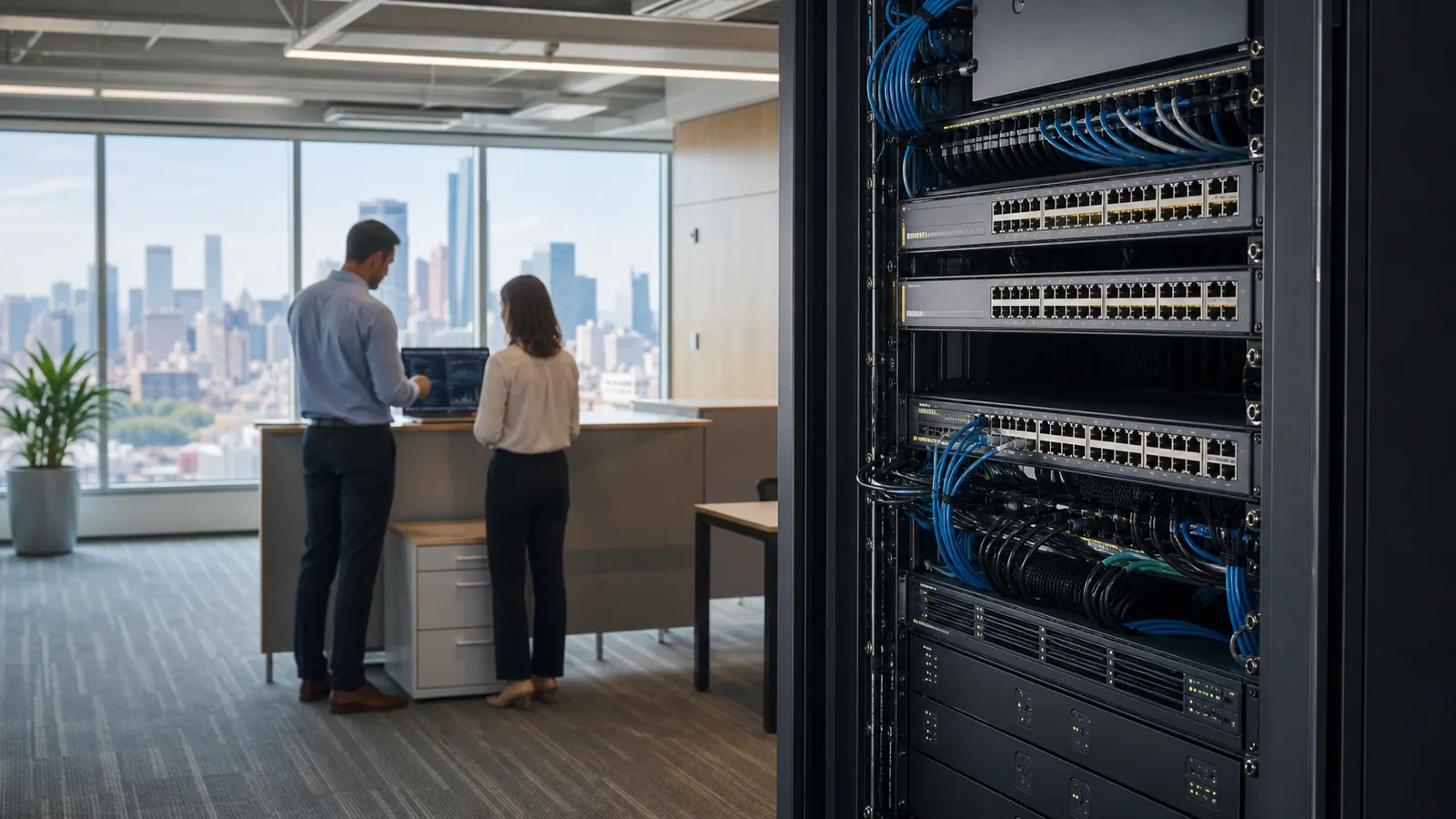
The New York IT Support problem LI Network Cabling needs to solve
Most technology requests arrive as a product name even though the real problem is missed work, an unreliable handoff, or responsibility split among several vendors. This Network Cabling Long Island page is written for a property or facilities team coordinating technology vendors. One issue to resolve is concern about losing internal control or administrative access. That issue deserves a direct answer, not a promise that software or a new contract will make every complication disappear. For responsive network cabling and physical infrastructure in New York, the discussion should identify the affected people, the task they are trying to complete, the acceptable interruption, and the person who can approve a change. Those facts create a useful brief for both leadership and the technical team. That is the business context behind IT Support New York on networkcablinglongisland.com.
Long Island Cabling Readiness approaches the subject through its established role: Infrastructure-first AI readiness for Long Island offices: switching, Wi-Fi, copper/fiber pathways, closet documentation, and the network prerequisites for managed automation. The practical scope remains network cabling and physical infrastructure, including pathways, copper and fiber links, MDF and IDF rooms, racks, patching, labels, Wi-Fi prerequisites, testing, and support handoff. Nothing on this page creates a claim of a new office, certification, award, staffing level, or guaranteed response. It explains how a buyer can recognize careful work and how Network Cabling Long Island can turn a loosely stated request into a reviewable next step for New York. For Long Island Cabling Readiness, those facts keep IT Support New York connected to a real operating need.
Local access and timing details for LI Network Cabling IT Support work in New York
New York brings a statewide mix of city offices, suburban branches, industrial properties, and remote staff. The planning friction is equally concrete: carrier choices, travel time, landlords, and local vendors differ even when the organization wants one standard. Those details belong in the schedule and the technical record because they influence access, timing, vendor coordination, and the difference between remote evidence and a condition somebody must see. Network Cabling Long Island should know the busy hours, property contact, equipment-room rules, and outside dependencies before committing to a disruptive window for responsive network cabling and physical infrastructure in New York. Those conditions shape the IT Support New York brief prepared for Long Island Cabling Readiness.
Consider a hypothetical operating example rather than a claimed customer story: a regional policy may be sound while the last-mile circuit, closet, call route, or recovery path behaves differently at each property. The purpose of the example is to test ownership. Who notices first, who can reproduce the symptom, which records exist, what temporary route is acceptable, and which provider receives the evidence? Answering those questions early keeps local conditions from becoming last-minute excuses. It also gives Long Island Cabling Readiness a way to distinguish an isolated fault from a repeatable weakness in the New York environment. In this New York scenario, Long Island Cabling Readiness must account for that dependency before IT Support New York work is scheduled.
What IT Support New York includes for LI Network Cabling—and what stays outside scope
For this page, responsive network cabling and physical infrastructure means disciplined work around pathways, copper and fiber links, MDF and IDF rooms, racks, patching, labels, Wi-Fi prerequisites, testing, and support handoff. Connect the first ticket to business impact, good evidence, the right escalation owner, and a fix that does not create a second problem. The proposal should name what is included, what remains the customer's responsibility, which third-party costs are separate, and how project work differs from ongoing support. Existing systems can remain when their ownership, condition, support status, capacity, compatibility, and risk are understood. Replacement needs an operating reason; uniformity alone is not one. On networkcablinglongisland.com, that is the declared boundary behind the phrase IT Support New York.
The brand boundary matters. Infrastructure-first AI readiness for Long Island offices: switching, Wi-Fi, copper/fiber pathways, closet documentation, and the network prerequisites for managed automation. On networkcablinglongisland.com, the phrase “IT Support New York” is interpreted through that role rather than used as permission to sell an unrelated bundle. A useful scope names deliverables, prerequisites, exclusions, change authority, acceptance tests, documentation, and the route for later help. That makes it possible to compare recommendations on common facts instead of comparing two polished proposals that quietly solve different problems. The IT Support New York scope for Long Island Cabling Readiness should remain inside that accountable service line.

How LI Network Cabling diagnoses IT Support constraints in New York
Discovery for responsive network cabling and physical infrastructure in New York should collect walkthrough notes, pathway capacity, cable type, termination condition, rack layout, power, grounding context, labeling, and certification results. Start with the symptom and work outward through the dependencies instead of starting with a favored product. Keep failed tests, timestamps, screenshots, carrier references, and user observations when they help another technician continue the investigation. The goal is not a giant inventory for its own sake. It is a short record that explains what is known, what is assumed, what still needs access, and which uncertainty can materially change the recommendation. That evidence is the starting record for IT Support New York at Long Island Cabling Readiness.
This page's working sequence is service-desk intake, severity definitions, escalation ownership, and recurring-ticket review. Network Cabling Long Island can apply that sequence to a property or facilities team coordinating technology vendors by separating urgent stabilization from ordinary maintenance, future improvement, and accepted risk. The objection—concern about losing internal control or administrative access—should appear in the decision log with an owner and an answer. When discovery ends, leadership should be able to see why the next action is necessary, what it affects, and what evidence will show that it worked. For this IT Support New York decision, Long Island Cabling Readiness should carry every unresolved fact into the next review.
Security controls LI Network Cabling builds into the New York IT Support plan
A defensible security baseline for network cabling and physical infrastructure includes controlled telecom-room access, separated device networks, protected switch administration, accurate port records, and removal of abandoned exposure. Controls must fit the people who operate them. If a setting leads staff to share accounts, bypass a call route, expose a recorder, prop open access, or store recovery credentials in the wrong place, the written policy and the real environment have diverged. Network Cabling Long Island should identify the owner, review frequency, exception path, and response action for the controls tied to responsive network cabling and physical infrastructure in New York. The resulting control record belongs to the IT Support New York scope on networkcablinglongisland.com.
Security review should also follow the actual workflow in New York. Check a representative user, device, path, account, and recovery action rather than assuming a dashboard covers everything intended. Record gaps without exaggerating them, rank them by business consequence, and distinguish corrective work from optional improvement. For Long Island Cabling Readiness, a useful result is understandable evidence: who can administer the system, how access changes, what is logged, how suspicious activity is escalated, and which residual risk leadership accepted. For Long Island Cabling Readiness, this is how IT Support New York becomes maintained behavior rather than sales language.
Continuity and recovery priorities for LI Network Cabling IT Support in New York
Continuity here means being able to trace carrier entry, backbone, switch, power, and horizontal links so a physical failure can be isolated without pulling apart the whole floor. Choose a believable loss and walk through the first hour. Decide who declares the problem, which communication channel remains trusted, what temporary method is allowed, which vendor must be engaged, and who confirms normal service. A plan that exists only in a policy document has not yet protected the New York workflow described on this page. That exercise gives the IT Support New York plan for Long Island Cabling Readiness a credible recovery baseline.
The recovery exercise should use as-built pathways, endpoint labels, test records, port maps, closet photographs where permitted, exceptions, and punch-list closeout as evidence. It does not need to become a theatrical disaster simulation, but it should expose missing credentials, unowned contracts, undocumented dependencies, unrealistic restoration estimates, and uncertain acceptance. Network Cabling Long Island can then assign each gap instead of leaving it inside a meeting note. This is especially important when carrier choices, travel time, landlords, and local vendors differ even when the organization wants one standard; an outage is the wrong time to discover that the technical fix depends on unavailable access or an unidentified account holder. The Long Island Cabling Readiness review should preserve those findings with the rest of the IT Support New York evidence.
How LI Network Cabling moves approved IT Support scope into tested service in New York
Implementation should follow service-desk intake, severity definitions, escalation ownership, and recurring-ticket review. Each change needs an owner, affected users, an approved window, prerequisites, a rollback condition, and an observable acceptance check. For network cabling and physical infrastructure, the finished record should include as-built pathways, endpoint labels, test records, port maps, closet photographs where permitted, exceptions, and punch-list closeout. The team should state what remains unchanged and why. That small discipline prevents a staged improvement from quietly becoming an uncontrolled migration. Those are the finish conditions for IT Support New York as scoped by Long Island Cabling Readiness.
Acceptance should resemble a normal business day in New York, not a technician's isolated test. Have the right person complete the relevant task, preserve the result, and note any limitation that remains. If another vendor or property team owns part of the path, give that party a concise handoff instead of an unexplained request to “check their side.” Long Island Cabling Readiness earns trust by making the boundary and the next owner visible even when the fault is outside its direct control. Within the Long Island Cabling Readiness plan, that handoff closes the implementation portion of IT Support New York.
When LI Network Cabling needs an on-site visit for IT Support in New York
Remote work is appropriate for configuration review, account work, interviews, logs, planning, and many support actions when access is authorized and recorded. A visit is warranted for pathway inspection, drilling or access coordination, pulling and terminating cable, fiber work, rack changes, labeling, and instrument testing. Before anyone travels, confirm the observed symptom, site contact, access rules, required tools or parts, other vendors, work window, and finish criteria. In New York, that preparation protects both response time and the customer's schedule. That distinction is part of the field plan for IT Support New York on networkcablinglongisland.com.
A field visit should return evidence, not just a verbal “all set.” Relevant photographs where permitted, labels, readings, test outputs, configuration references, user acceptance, exceptions, and the next action belong in the shared record. Network Cabling Long Island can then connect physical findings to later remote support. That link is essential for a property or facilities team coordinating technology vendors, because the next person handling the issue should not have to rediscover the same room, device, call path, or property constraint. For Long Island Cabling Readiness, a prepared visit makes the IT Support New York record more useful after the technician leaves.
Organizations in New York that fit the LI Network Cabling IT Support approach
This approach commonly fits offices, warehouses, clinics, legal suites, multi-floor properties, and organizations preparing networks for higher-throughput workloads. It is particularly useful when several vendors touch one workflow, recurring issues have become normal, an office move or renewal is approaching, or management cannot see where responsibility changes hands. Fit is weaker when the request is a one-time consumer problem, the organization will not identify an owner, or the expected outcome depends on an unsupported guarantee. Network Cabling Long Island should say so rather than stretching responsive network cabling and physical infrastructure in New York beyond the site's credible role. That is the fit boundary for IT Support New York as presented by Long Island Cabling Readiness.
A practical fit test uses five questions: Is the business consequence clear? Can the current condition be observed? Is someone authorized to approve work? Can the result be tested? Will the records be usable after the project team leaves? The answers help Long Island Cabling Readiness decide whether the next move is a remote review, site survey, stabilization task, formal project, ongoing service discussion, or simply a referral to the correct existing vendor. The answer determines whether IT Support New York on networkcablinglongisland.com should advance beyond an initial review.
How LI Network Cabling onboards IT Support work in New York without a surprise cutover
A low-disruption start does not require replacing everything at once. Bring a recent example, the affected workflow, known accounts and vendors, operating hours, upcoming deadlines, and any building or access restrictions. Network Cabling Long Island can use the existing homepage form and the brand telephone (516) 232-8932 to decide what evidence is needed before a recommendation. The first useful result may be a survey, call-flow review, recovery check, ownership map, or prioritized repair—not a broad contract. That is a proportionate opening move for IT Support New York with Long Island Cabling Readiness.
For responsive network cabling and physical infrastructure in New York, ask for a written next step that names the decision, evidence, owner, timing, expected result, and follow-up. That directly addresses concern about losing internal control or administrative access while respecting the operating reality of New York. A focused conversation is successful when both sides understand what will happen next and what has deliberately not been promised. The next-step record should name IT Support New York, New York, and Long Island Cabling Readiness so the request cannot drift into a generic pitch.